
Federal sentencing in the United States has entered a new era, one defined by judicial discretion, regional disparities, and renewed debate about fairness in the criminal justice system. A recent study by the U.S. Sentencing Commission has brought these issues into sharp focus, revealing that defendants facing similar federal charges can receive dramatically different sentences depending on the judge assigned to their case. In some jurisdictions, these differences are not marginal but staggering.
At the center of this national conversation is Philadelphia, identified as the city with the widest sentencing gap in the country. According to the study, federal prison sentences in Philadelphia can vary by as much as 63 percent between judges. This finding, highlighted in a major investigative piece by The Guardian, underscores a fundamental tension in federal criminal law: the balance between consistency and individualized justice.
The U.S. Sentencing Commission Study Explained
The U.S. Sentencing Commission, an independent agency within the judicial branch, conducts ongoing research into federal sentencing practices. Its latest analysis examined sentencing outcomes nationwide and compared how different judges apply federal sentencing guidelines in similar cases.
The results were striking. While some variation is expected, the data showed that sentencing outcomes can swing widely not only between states, but even among judges sitting in the same federal courthouse. Philadelphia emerged as the most extreme example, with a 63 percent difference in sentence length depending on the presiding judge.
These findings raise important questions for defendants, attorneys, and policymakers alike. Is this level of disparity a sign of injustice, or does it reflect a necessary flexibility within the system?
Understanding Judicial Discretion in Federal Court
To understand how federal sentencing reached this point, it is essential to revisit a landmark Supreme Court decision: U.S. v. Booker. Prior to this ruling, federal judges were required to impose sentences within strict guideline ranges. These ranges were largely mandatory, leaving judges little room to account for the unique facts of each case or the individual circumstances of a defendant.
In Booker, the Supreme Court struck down the mandatory nature of these guidelines, holding that they violated the Sixth Amendment. The decision transformed the guidelines from binding rules into advisory benchmarks. Judges must still consider them, but they now have broad discretion to depart upward or downward based on statutory sentencing factors.
This shift restored significant power to federal judges and fundamentally changed sentencing dynamics across the country.
Philadelphia’s Sentencing Gap and What It Means
Philadelphia’s 63 percent sentencing disparity has drawn particular attention because it highlights how dramatically discretion can influence outcomes. Two defendants charged with similar offenses, possessing comparable criminal histories, may walk away with vastly different sentences depending on which judge hears their case.
Critics argue that such discrepancies undermine public confidence in the justice system and create unpredictability for defendants. Supporters counter that rigid uniformity ignores human complexity and can lead to unjust outcomes when judges are forced into a narrow sentencing box.
This debate sits at the heart of modern federal sentencing policy.
NiaLena Caravasos on the Human Side of Sentencing
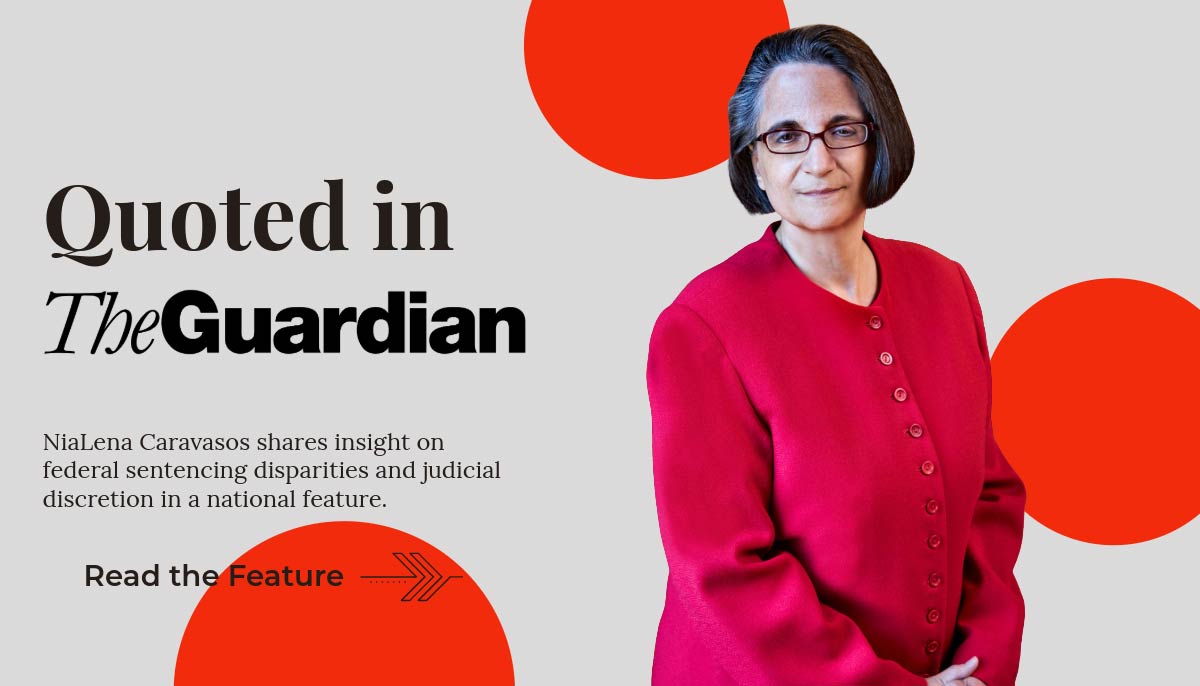
One of the most compelling voices in this discussion is NiaLena Caravasos, a respected federal criminal defense and white-collar crime lawyer who regularly represents defendants in federal court in Philadelphia. Her perspective was featured prominently in The Guardian article reporting on the Sentencing Commission’s findings.
NiaLena strongly supports judicial discretion, emphasizing that sentencing should never be reduced to a mechanical process. She explained that when judges are overly constrained, they lose the ability to apply empathy, judgment, and real-world understanding to the cases before them. In her view, discretion is not a flaw in the system but one of its most important safeguards.
She has noted that judges are not robots and should not be treated as such. Each judge brings a unique background, philosophy, and set of priorities to the bench, and understanding those factors is a critical part of effective federal defense advocacy.
Why Judge-by-Judge Differences Matter in Federal Defense Strategy
From a defense perspective, sentencing discretion changes everything. Attorneys can no longer rely solely on numerical guideline calculations. Instead, they must craft narratives that resonate with the judge as a decision-maker, not just a rule-enforcer.
NiaLena has consistently emphasized the importance of understanding how a particular judge views punishment, rehabilitation, deterrence, and fairness. Some judges place heavy weight on personal history and post-offense conduct. Others focus more on general deterrence or policy considerations. Effective advocacy requires identifying these priorities and tailoring arguments accordingly.
This approach demands deeper preparation, stronger storytelling, and a more nuanced presentation of mitigation evidence.
The Debate Over Consistency Versus Individualized Justice
The sentencing disparities highlighted by the U.S. Sentencing Commission have reignited calls for reform. Some policymakers advocate for tighter guideline controls to reduce variability and promote consistency nationwide. They argue that justice should not depend on geography or judicial assignment.
Others, including many defense attorneys, caution against rolling back discretion. They contend that mandatory systems historically produced harsh, disproportionate sentences and stripped judges of the ability to recognize genuine differences between cases.
NiaLena has aligned firmly with the latter view. She has expressed a preference for working within a discretionary system, even when facing a challenging judge, rather than returning to rigid rules that leave no room for persuasion or humanity.
What This Means for Defendants Facing Federal Charges
For individuals charged in federal court, the implications are profound. Sentencing is no longer a predictable mathematical exercise. It is a complex process shaped by advocacy, judicial philosophy, and case-specific facts.
Defendants benefit most from counsel who understands not only the law, but also the courtroom dynamics and sentencing tendencies of individual judges. This level of insight can influence decisions ranging from plea strategy to the development of mitigation materials and expert reports.
The Guardian’s reporting, combined with voices like NiaLena’s, highlights how critical experienced federal defense representation has become in the post-Booker era.
The Future of Federal Sentencing in the United States
As data continues to expose disparities, federal sentencing will remain under scrutiny. Whether reforms move toward greater uniformity or reaffirm judicial discretion, the conversation itself reflects a justice system grappling with its core values.
Philadelphia’s example serves as a powerful case study, illustrating both the risks and rewards of discretion. On one hand, outcomes can vary widely. On the other, judges retain the freedom to impose sentences that reflect individual circumstances rather than one-size-fits-all mandates.
For now, judicial discretion remains a defining feature of federal sentencing. And as long as that discretion exists, thoughtful advocacy and a deep understanding of judicial perspective will continue to play a decisive role in shaping outcomes.
In this evolving landscape, the insights of practitioners like NiaLena Caravasos provide a critical reminder: justice is not only about rules and numbers, but about people, judgment, and the careful exercise of human decision-making.


