
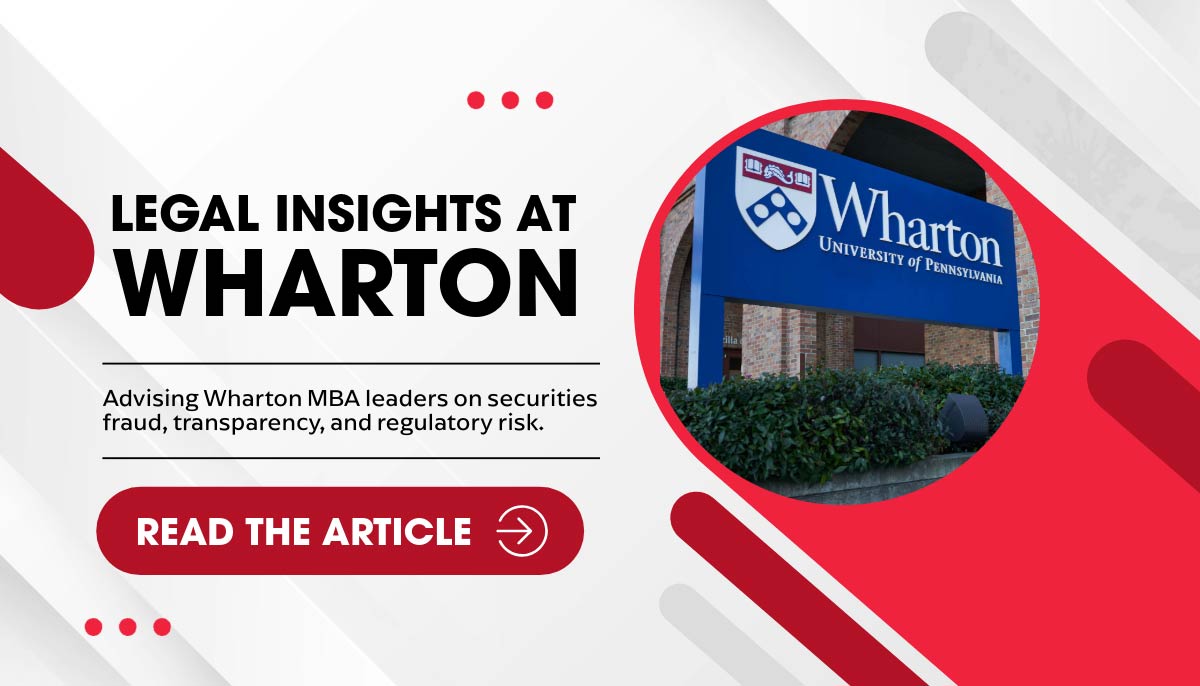
Advising Future Business Leaders on Securities White Collar Fraud
Nationally recognized Philadelphia federal criminal defense and white-collar crime attorney NiaLena Caravasos returned to her alma mater, The Wharton School at the University of Pennsylvania, to serve as a legal advisor to an advanced MBA class focused on the securities industry. This invitation reflects not only her professional reputation but also Wharton’s commitment to exposing experienced executives to real-world legal analysis at the intersection of finance, ethics, and regulation.
The class consisted of seasoned professionals who had previously held executive roles across finance and business and returned to academia to sharpen their strategic and leadership skills. Rather than studying theory in isolation, students engaged in a rigorous, practical examination of securities regulation, broker-dealer obligations, and the legal risks that arise when transparency breaks down.
This session built on prior engagements, including her return to Wharton as a CLE instructor on white-collar fraud, reinforcing the importance of practical legal insight in executive and professional education.
A Realistic Securities Industry Case Study
At the center of the discussion was a detailed case study involving a brokerage house accused of failing to disclose conflicts of interest and an agent alleged to have attempted to defraud an investor. Although the scenario did not result in a direct monetary loss, it raised critical questions that frequently surface in securities investigations and white-collar defense matters.
The case challenged students to evaluate conduct not just through a financial lens, but through regulatory, ethical, and reputational frameworks. It also highlighted how quickly routine business decisions can escalate into potential securities fraud exposure when disclosure obligations are ignored or mishandled.
Conflict of Interest and Disclosure Obligations
One of the most heavily debated topics involved conflict of interest transparency within brokerage firms. In the securities industry, disclosure is not optional. Firms and registered representatives must proactively inform investors of any conflicts that could influence recommendations or transactions.
Students examined how even perceived conflicts can erode trust and trigger regulatory scrutiny. The discussion emphasized that transparency protects not only investors, but also firms and advisors themselves. When disclosures fall short, firms expose themselves to civil liability, regulatory enforcement actions, and long-term reputational harm.
Investor Complaints Without Financial Loss
A key issue explored during the session was whether an investor can maintain a legitimate complaint in the absence of monetary loss. From a legal perspective, harm in securities matters does not always require immediate financial damage.
Reputational risk, lost opportunity, breach of fiduciary duty, and erosion of informed consent can all support regulatory or civil claims. Students learned that regulators and enforcement agencies often focus on conduct and intent rather than outcomes alone, including the underlying motives behind white collar crime, which often shape how cases are evaluated long before any financial loss occurs. This distinction plays a critical role in both prosecution strategies and defense planning in white collar cases.
Managing a Misstep by a High-Performing Agent
Another complex dimension involved the brokerage agent accused of misconduct. The agent had allegedly misstepped in this instance but had also served as a top revenue producer for the firm over many years.
The class explored how firms should respond when high-performing employees engage in questionable conduct. Ignoring misconduct because of profitability can significantly worsen exposure. Prompt internal review, corrective action, and compliance reinforcement often mitigate regulatory risk and demonstrate good faith.
This portion of the discussion underscored the importance of consistent compliance enforcement across all levels of an organization, regardless of an individual’s financial contribution.
Negotiated Resolutions Versus Litigation Risk
A central theme of the session focused on the possibility of resolving securities disputes through negotiated agreements rather than adversarial proceedings. Litigation and arbitration introduce uncertainty, expense, and public exposure for all parties involved.
Students analyzed whether structured negotiation could address investor concerns, remediate compliance failures, and preserve business relationships. They also examined how early resolution can reduce regulatory scrutiny and prevent escalation into criminal or quasi-criminal proceedings.
This strategic approach reflects NiaLena Caravasos’ Art of War philosophy, emphasizing that anticipating risk, controlling outcomes, and resolving disputes efficiently are often more effective than prolonged litigation. This analysis reflects real-world decision-making in white-collar defense, where strategic negotiation frequently yields better results than extended litigation.
Regulatory Reporting and FINRA Considerations
An especially nuanced discussion revolved around whether a negotiated resolution could occur without triggering mandatory reporting to Financial Industry Regulatory Authority. Regulatory disclosures can carry lasting professional consequences for firms and registered representatives.
Students learned how reporting requirements influence settlement strategy, internal investigations, and compliance decisions. Understanding when reporting becomes mandatory and how to structure remedial actions within regulatory boundaries is critical for brokerage firms navigating potential enforcement exposure.
Transparency as a Cornerstone of Securities Compliance
Throughout the session, transparency emerged as the dominant principle underlying securities regulation. Clear disclosures, accurate representations, and ethical conduct form the foundation of investor confidence and market integrity.
The discussion reinforced that transparency must extend beyond formal documentation. Firms must foster internal cultures where compliance concerns are addressed proactively and ethical considerations guide business decisions.
Preventive compliance measures, including training, audits, and robust supervisory systems, play a vital role in reducing the likelihood of future violations.
Preparing MBA Leaders for Legal and Ethical Decision-Making
This Wharton MBA session demonstrated the value of integrating legal analysis into executive education. Business leaders increasingly face regulatory complexity, especially in financial services and securities markets. Exposure to real-world white-collar scenarios equips future executives with the tools to identify risk early and respond strategically.
By engaging directly with an experienced federal criminal defense attorney, students gained insight into how regulators, prosecutors, and defense counsel evaluate conduct behind closed doors. These perspectives are rarely captured fully in textbooks, yet they shape outcomes in high-stakes investigations.
Bridging Academia and Real-World Securities Enforcement
The invitation extended to NiaLena Caravasos highlights the importance of bridging academic instruction with practical legal experience. For MBA candidates preparing to reenter leadership roles, understanding securities law is no longer optional. It is a core component of responsible governance and sustainable growth.
This session offered a rare opportunity to analyze securities fraud, conflict of interest issues, and regulatory risk through the lens of actual enforcement considerations. It reinforced that informed, ethical decision-making remains the strongest defense against white collar exposure in the modern securities industry.
By confronting these issues before they arise in real boardrooms, Wharton continues to prepare its graduates to lead with integrity, foresight, and legal awareness in an increasingly regulated business environment.


